.AudioStageGearLogo2.0737x200px650x200px600x200px-e0b2c59d793c2a4d3bf8a89c01050dc5f800fc7b531c8421e4533d9afac137a3.png)
NYC Event Sound Checklist: What to Prepare Before Requesting a Quote
Planning sound for an event in New York City involves much more than deciding how many speakers you need.
Venue access, electrical power, room dimensions, DJ and artist requirements, load-in restrictions, production schedules and expected attendance can all change the equipment, crew and setup required for an event.
Providing this information early helps your sound company design the right system, avoid unnecessary equipment and give you a much more accurate quote.
At Audio Stage Gear, we provide professional sound system rentals and complete event production throughout NYC, with larger BASSBOSS deployments available across the Northeast.
Before requesting a sound quote, here is the information you should gather.
1. Venue Name and Address
Start with the exact venue and event location.
If the production company has worked there previously, they may already understand some of the venue's challenges, including:
- Loading areas
- Freight elevators
- Stair access
- Power availability
- Noise restrictions
- Speaker placement limitations
- Venue curfews
- Load-in procedures
NYC venues can vary enormously. A Manhattan ballroom, Brooklyn warehouse, rooftop, nightclub and historic building may require completely different production plans even when the guest counts are similar.
If you have a venue floor plan, include it with your quote request.
2. Load-In and Venue Access
Access is one of the most important details when calculating an event production quote.
Tell your production company whether the venue has:
- Street-level loading
- Loading dock access
- Freight elevator
- Passenger elevator only
- Stairs
- Long equipment pushes from the truck
- Limited loading-zone availability
- Scheduled dock appointments
- Union labor requirements
A sound system containing multiple large-format subwoofers and speakers can involve thousands of pounds of equipment.
A ground-floor installation with direct truck access is very different from moving the same system through hallways, elevators or several flights of stairs.
In NYC, parking and loading restrictions can also significantly affect labor and transportation planning.
3. Event Schedule
Provide the complete production schedule if possible.
At minimum, include:
- Venue access time
- Load-in time
- Setup window
- Sound-check time
- Doors
- Event start
- Event end
- Breakdown window
- Required building exit time
A professional system should ideally be completely installed, tested and tuned before guests arrive.
Trying to compress a large sound-system installation into an unrealistic setup window can require additional technicians or substantially change the equipment deployment.
For larger events, allowing adequate time for system tuning is particularly important.
4. Expected Attendance
Tell your sound provider how many people you expect.
But attendance alone does not determine the required system.
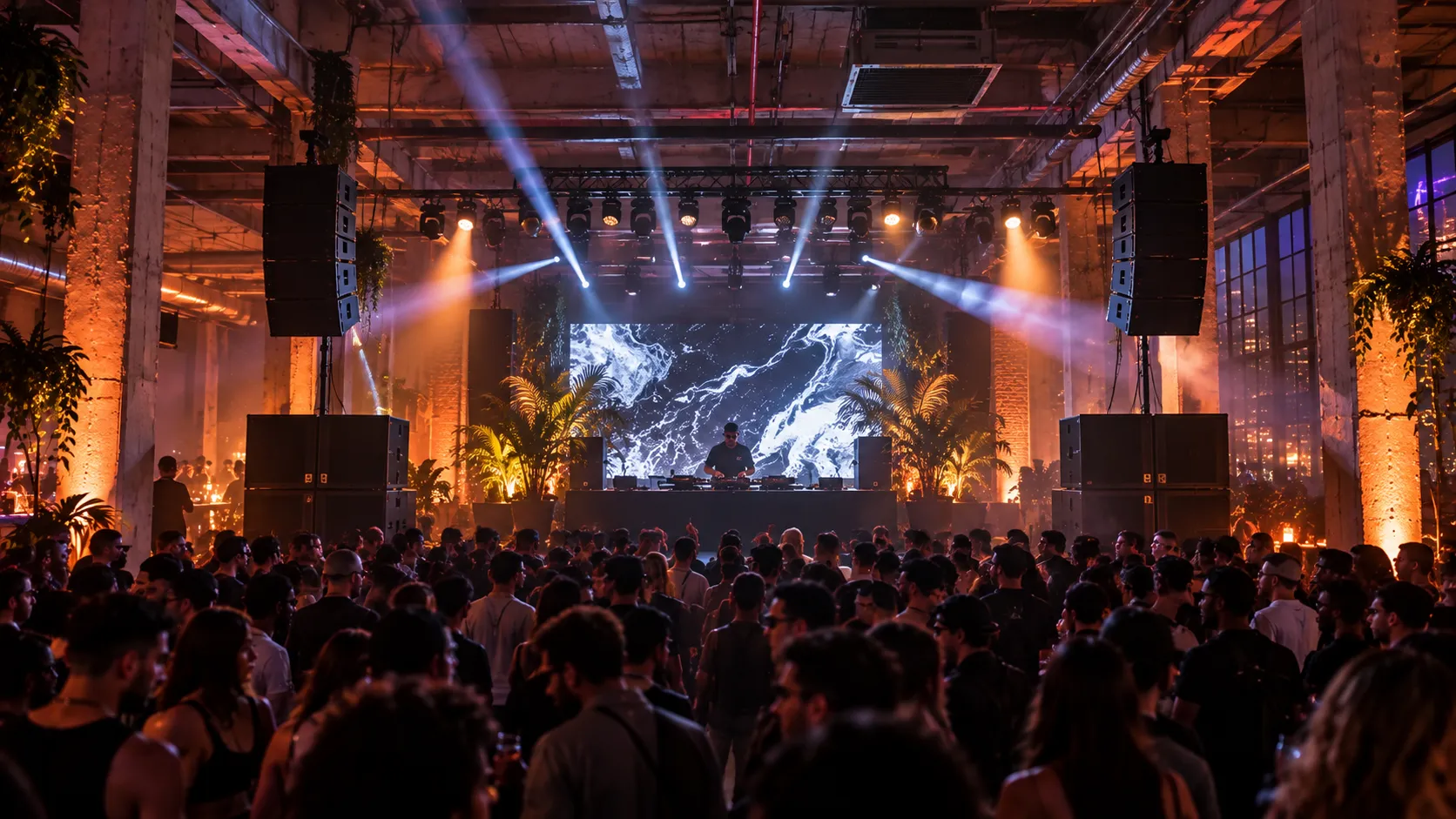
A 500-person seated corporate presentation requires very different sound reinforcement from a 500-person electronic-music event.
Important information includes:
- Expected guest count
- Seated or standing
- Dance floor size
- Indoor or outdoor
- Type of music
- Desired sound level
- Whether guests occupy multiple rooms or floors
For dance music, concerts and nightlife events, low-frequency output and consistent coverage become particularly important.
5. Floor Plans and Room Dimensions
Whenever possible, send a floor plan.
Useful measurements include:
- Room width
- Room length
- Ceiling height
- Stage location
- DJ booth location
- Dance floor
- Bars
- VIP areas
- Balconies
- Columns and obstructions
Good sound-system design is about coverage, not simply placing two speakers beside a stage.
Depending on the venue, the system may require main speakers, center fills, front fills, delays, balcony fills or distributed speakers to maintain consistent sound throughout the audience area.
The objective is to cover the room evenly without forcing the main speakers to be unnecessarily loud.
6. Available Electrical Power
Power is one of the first things that should be confirmed for a professional sound system.
Ask the venue what electrical service is available near the planned sound-system locations.
Useful information includes:
- Number of circuits
- Circuit amperage
- Circuit locations
- Whether circuits are dedicated
- Whether lighting shares those circuits
- Availability of 208V or 240V service
- Available three-phase power
- Generator availability for outdoor events
Do not assume that because a venue has many outlets, it has sufficient power.
Several outlets may be connected to the same electrical circuit.
Large concert and electronic-music systems can require dedicated power distribution, particularly when substantial subwoofer systems are involved.
7. DJ Backline Requirements
If DJs are performing, specify exactly what equipment they require.
For example:
- Pioneer DJ / AlphaTheta CDJ-3000
- CDJ-3000X
- DJM-A9
- DJM-V10
- RMX-1000
- Turntables
- Additional media players
- Laptop connections
- DJ monitors
Do not simply write "Pioneer setup."
Different DJs may request completely different configurations.
For events with multiple artists, request the technical riders before finalizing the equipment order.
8. Artist Technical Riders
For concerts and larger nightlife events, collect artist riders as early as possible.
Technical riders may specify:
- DJ equipment
- Microphones
- Monitor requirements
- Input lists
- Stage plots
- Mixer requirements
- DI boxes
- Playback systems
- Wireless equipment
- In-ear monitors
- Additional power
Send all riders to the sound provider together.
This allows the system to be designed around the complete event rather than discovering additional requirements during setup.
9. DJ Booth Monitor Requirements
Booth monitoring is frequently overlooked.
A DJ performing beside a powerful main sound system needs sufficient monitoring to hear accurately over the room.
Depending on the event, this might involve:
- One or two professional monitors
- Full-range monitors with dedicated subwoofers
- Independent booth volume control
For high-output electronic-music events, booth monitoring should be considered part of the system design, not an afterthought.
10. Stage and Speaker Placement Restrictions
Ask the venue where speakers are permitted.
Important questions include:
- Can speakers be placed on the floor?
- Can speakers be flown?
- Are there rigging points?
- Are speaker stands permitted?
- Can subwoofers be placed in front of the stage?
- Are there emergency-exit clearance requirements?
- Are there sightline restrictions?
- Are there weight restrictions?
Historic NYC venues in particular can have significant limitations regarding rigging and equipment placement.
Knowing those restrictions before equipment arrives can prevent major production problems.
11. Rigging Information
If any equipment will be suspended, obtain the venue's rigging requirements.
This may include:
- Approved rigging vendors
- Structural load limits
- Rigging-point locations
- Engineer approvals
- Insurance requirements
- Union requirements
Never assume that a speaker or lighting fixture can simply be attached to an existing structure.
Rigging should always be planned and executed by qualified professionals.
12. Sound Restrictions and Venue Limits
Many NYC venues have sound restrictions.
Ask about:
- Maximum permitted dBA
- Measurement location
- Frequency-specific restrictions
- Outdoor sound limitations
- Curfew
- Residential neighbors
This information affects both system design and speaker placement.
A properly distributed sound system can sometimes produce better audience coverage while reducing unnecessary sound outside the venue.
13. Indoor or Outdoor Event
Outdoor sound requires additional planning.
Unlike indoor venues, outdoor events receive very little acoustic reinforcement from walls and ceilings.
Your sound provider needs to know about:
- Audience dimensions
- Stage dimensions
- Expected attendance
- Power availability
- Weather protection
- Noise ordinances
- Generator location
- Distance to neighboring properties
Weather planning is especially important because professional loudspeakers, DJ equipment and electrical distribution must be adequately protected.
14. Production Responsibilities
Clarify what the venue or other vendors are already providing.
For example:
Venue provides:
- Stage
- House lighting
- Electrical service
- Rigging points
Sound company provides:
- Main PA
- Subwoofers
- Fills
- DJ monitors
- DJ equipment
- Digital mixer
- Cabling
- Power distribution
- Sound engineer
Clearly defining responsibilities prevents duplicated rentals and last-minute surprises.
15. Certificate of Insurance Requirements
Many NYC venues require vendors to provide a Certificate of Insurance before entering the building.
Ask the venue for the exact insurance requirements and additional-insured wording.
Send those requirements to your production vendor as early as possible.
Waiting until the day before the event to request insurance documentation can delay venue approval or load-in.
16. Budget
Providing a realistic budget can actually help your sound company design a better system.
Professional audio systems can often be scaled intelligently.
For example, if the original design exceeds the available budget, it may be possible to modify:
- Subwoofer quantity
- Fill-speaker quantity
- DJ equipment
- Monitor configuration
- Crew size
- Production scope
The goal should be to preserve the elements that have the greatest impact on sound quality and audience experience.
Information to Send With Your Sound Quote Request
For the fastest and most accurate quote, send:
- Event name
- Event date
- Venue name and address
- Guest count
- Event type
- Music type
- Floor plan
- Stage dimensions
- DJ booth dimensions
- Production schedule
- Load-in information
- Available electrical power
- Artist technical riders
- DJ backline requirements
- Sound restrictions
- Venue insurance requirements
- Approximate budget
Even if some information is unavailable, send what you have. The production company can help identify what still needs to be confirmed.
Why This Matters
The best event sound systems are designed around the venue rather than selected from a generic package.
Speaker dispersion, subwoofer placement, audience geometry, room dimensions, power and sound-level requirements all influence the final deployment.
For larger events, Audio Stage Gear can plan combinations of BASSBOSS subwoofers, main speakers, fills and DJ monitors around the actual venue layout.
This can provide more even coverage while reducing dead zones and excessive volume near the stage.
Professional Event Sound Rental in NYC
Audio Stage Gear provides professional sound-system rentals and event production for:
- Nightclubs
- Warehouse events
- Concerts
- Festivals
- Corporate events
- Private events
- Fashion events
- Rooftops
- Weddings
- DJ events
- Large-scale electronic-music events
Our inventory includes professional BASSBOSS subwoofers, main speakers, fills and monitors, along with Pioneer DJ / AlphaTheta DJ backline, digital mixing, staging, lighting, lasers and LED video walls.
Systems can range from compact event packages to high-output deployments designed for large dance floors, concerts and festivals.
We primarily serve Manhattan, Brooklyn, Queens, the Bronx and Staten Island, with larger sound-system deployments available throughout New Jersey and the Northeast.
Request an NYC Event Sound Quote
Have your event date, venue, expected attendance and production schedule ready?
Request Your NYC Event Sound Quote
Audio Stage Gear
Concert Quality, Without Compromise.
audiostagegear.com